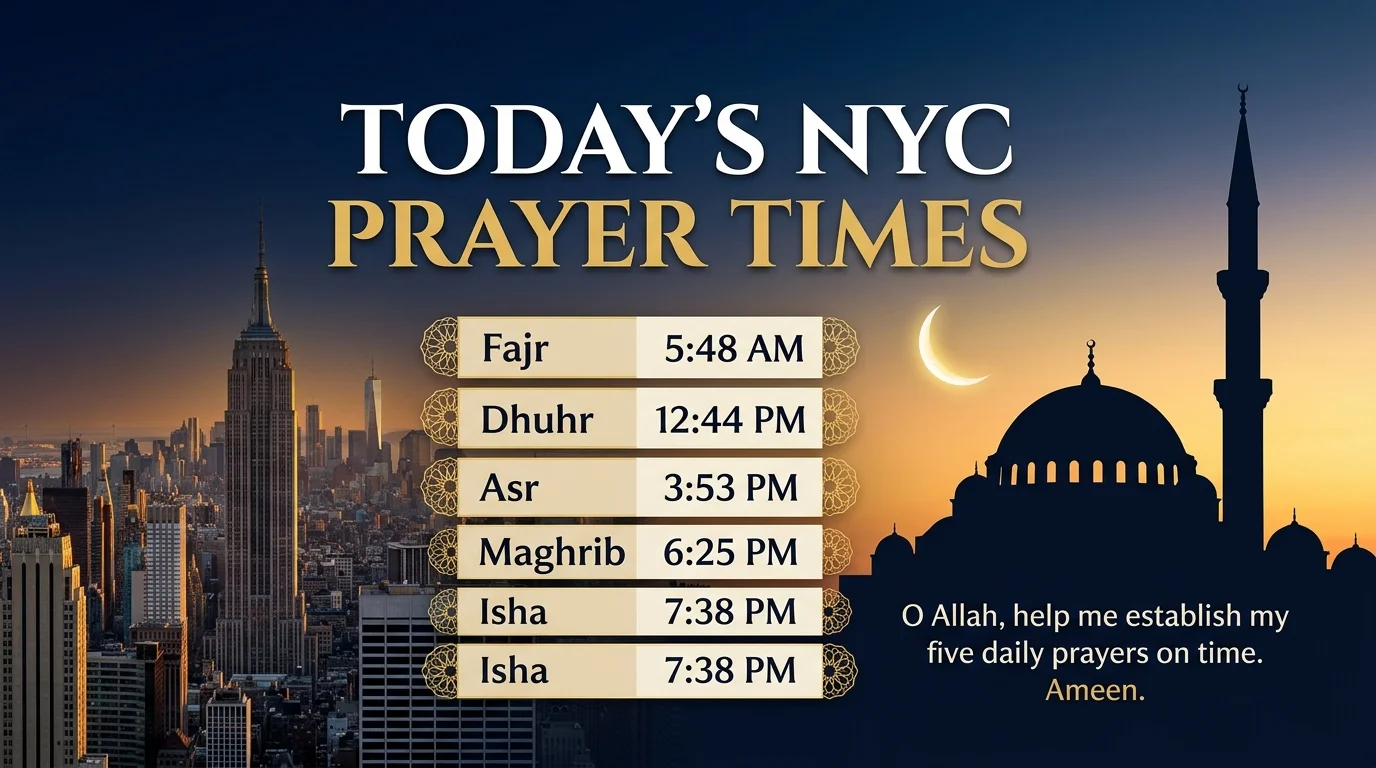
Today’s prayer times NYC are Fajr 5:48 AM, Dhuhr 12:44 PM, Asr 3:53 PM, Maghrib 6:25 PM and Isha 7:38 PM. These follow the Islamic Society of North America (ISNA) method.
The sun sets the schedule, so NYC namaz timing shifts every day. This guide gives the full list, how it is worked out, and how to stay on time in the city.
Table of Contents
Today’s Prayer Times NYC (Fajr, Dhuhr, Asr, Maghrib & Isha)
Here is the Salah time in New York City for today, October 11, 2026. Each time marks when the prayer window opens.
Prayer
Starts
Window ends
Fard rakat
Fajr
5:48 AM
Sunrise (7:01 AM)
2
Dhuhr
12:44 PM
When Asr starts
4
Asr
3:53 PM
Sunset
4
Maghrib
6:25 PM
When Isha starts
3
Isha
7:38 PM
Before Fajr
4
Other useful times:
Sunrise: 7:01 AM. Do not pray from sunrise until the sun has risen a spear’s length.
Ishraq: Starts about 15 to 20 minutes after sunrise.
Qiyam (night prayer): Best in the last third of the night. This is around 2:00 AM now.
Fajr begins at true dawn, called Fajr al-Sadiq. That is when the first thin line of light spreads across the horizon. Maghrib begins as soon as the sun fully sets.
Online tools can differ by a few minutes. Rounding and safety buffers cause this. If your mosque posts its own Azan time, follow it.
The Hijri date can also differ by one day. That depends on moon sighting.
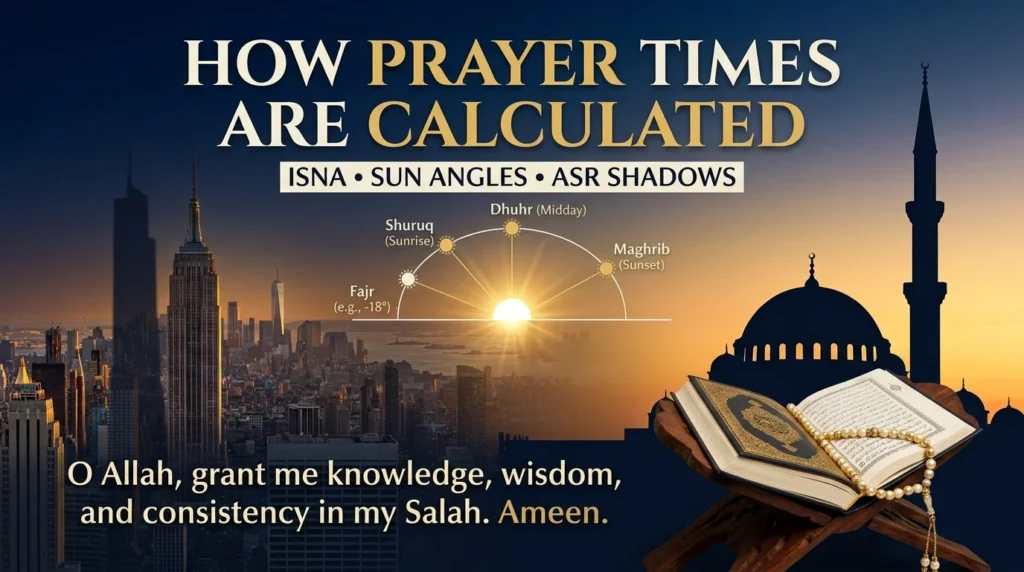
How NYC Prayer Times Are Calculated
Prayer times come from the sun’s position, so they are exact science. Here is how Islamic prayer times in New York City are worked out.
Fajr and Isha depend on how far the sun sits below the horizon. Each calculation method uses a different angle:
ISNA: 15 degrees for both Fajr and Isha. Used across the US and Canada.
Muslim World League: 18 degrees for Fajr, 17 for Isha.
Egyptian General Authority of Survey: 19.5 and 17.5 degrees.
University of Islamic Sciences, Karachi: 18 degrees for both.
A bigger angle means an earlier Fajr and a later Isha. That is why two sources can disagree.
Asr also depends on your school of thought:
Shafi’i, Maliki and Hanbali: Asr starts when an object’s shadow equals its height.
Hanafi: Asr starts when the shadow is twice its height. This is later.
Pick one method and stay with it.
The five boroughs sit close together. Times usually vary by about a minute from one corner of the city to another.
For checking the raw data, see the U.S. Naval Observatory and the NOAA solar calculator.
While staying mindful of daily prayer times and spiritual reflection, it’s also natural to seek comfort and connection through meaningful messages and shared humor. Explore these thoughts and prayers memes for a mix of funny, relatable, and heartfelt ways to express support and encouragement during life’s challenging moments.
How NYC Prayer Times Change Through the Year
New York has long summer days and short winter days. Every Muslim prayer time in NYC moves with them.
Daylight Saving Time is the biggest jump. It ends on Sunday, November 1, 2026, when clocks go back one hour. Read more at NIST.
Here is the effect:
Fajr moves from 5:48 AM today to about 5:10 AM on November 1.
Maghrib moves from 6:25 PM today to about 4:52 PM.
Isha moves from 7:38 PM today to about 6:09 PM.
The seasons add to this:
Summer: Maghrib comes around 8:30 PM and Isha near 10 PM. Fajr is very early.
Winter: Maghrib comes around 4:30 PM. Days feel short, so plan work and school around Asr and Maghrib.
Jumu’ah (Friday prayer) is held at Dhuhr time. Many NYC mosques hold more than one session, so check your local schedule.
In Ramadan, Suhoor ends at Fajr, and Iftar starts at Maghrib. Never break the fast early.
How to Pray on Time in New York City
NYC moves fast, but small habits keep Salah on time. Here are simple ways to do it.
Use tools and your local mosque:
Set an Athan app alert for each prayer.
Check your mosque’s board. Many post Iqamah times, which are later than the start time.
The Islamic Cultural Center of New York on East 96th Street in Manhattan is the city’s most prominent mosque. Brooklyn and Queens have the most mosques, about one-third each.
Pray anywhere clean:
Find the Qibla. In NYC it points northeast, at about 58 degrees from north.
Keep a small prayer mat or scarf in your bag.
Offices, campuses and parks often have a quiet corner. Ask for a prayer room.
Make Wudu at a restroom sink, and pray short if you must.
Plan around the clock:
Pray Dhuhr during a lunch break.
Pray Asr before the evening rush.
Do not delay Maghrib. Its window is short.
FAQs
Here are quick answers to common questions about prayer times in New York.
What time is pray time in New York?
Today’s times are Fajr 5:48 AM, Dhuhr 12:44 PM, Asr 3:53 PM, Maghrib 6:25 PM and Isha 7:38 PM. Times change daily. After November 1, 2026, every prayer moves one hour earlier on the clock.
Can I pray Maghrib 20 minutes early?
No. Maghrib begins at sunset. A prayer offered before its time is not valid, so wait until the sun has fully set. Some scholars allow joining Maghrib with Isha during travel or heavy rain. Views differ, so ask a qualified scholar.
Where do most Muslims live in NYC?
Most live in Queens and Brooklyn. Estimates for the city range from about 600,000 to 800,000 people, and surveys count differently. PRRI reports that New York City has a higher share of Muslims than the US average. Well-known areas include Astoria, Jackson Heights and Bay Ridge. The Bronx and Manhattan also have large communities.
What time do Muslims pray in the US?
Muslims pray five times a day: Fajr, Dhuhr, Asr, Maghrib and Isha. Exact times depend on the city and the season. For example, northern cities have very late Isha in summer. Always check a local source for your own city.
Conclusion
The five daily prayer times in NYC change with the sun, the season and Daylight Saving Time. Check today’s list, follow one calculation method, and trust your local mosque for Iqamah. Bookmark this page and return daily for the latest Islamic prayer schedule.
Hassan Abroy is the founder and writer behind Morning Prayer Hub, where he shares daily prayers and devotionals to help readers begin each day with faith, gratitude, and a quiet mind. He writes with a simple goal: to make prayer feel accessible, personal, and part of everyday life.